
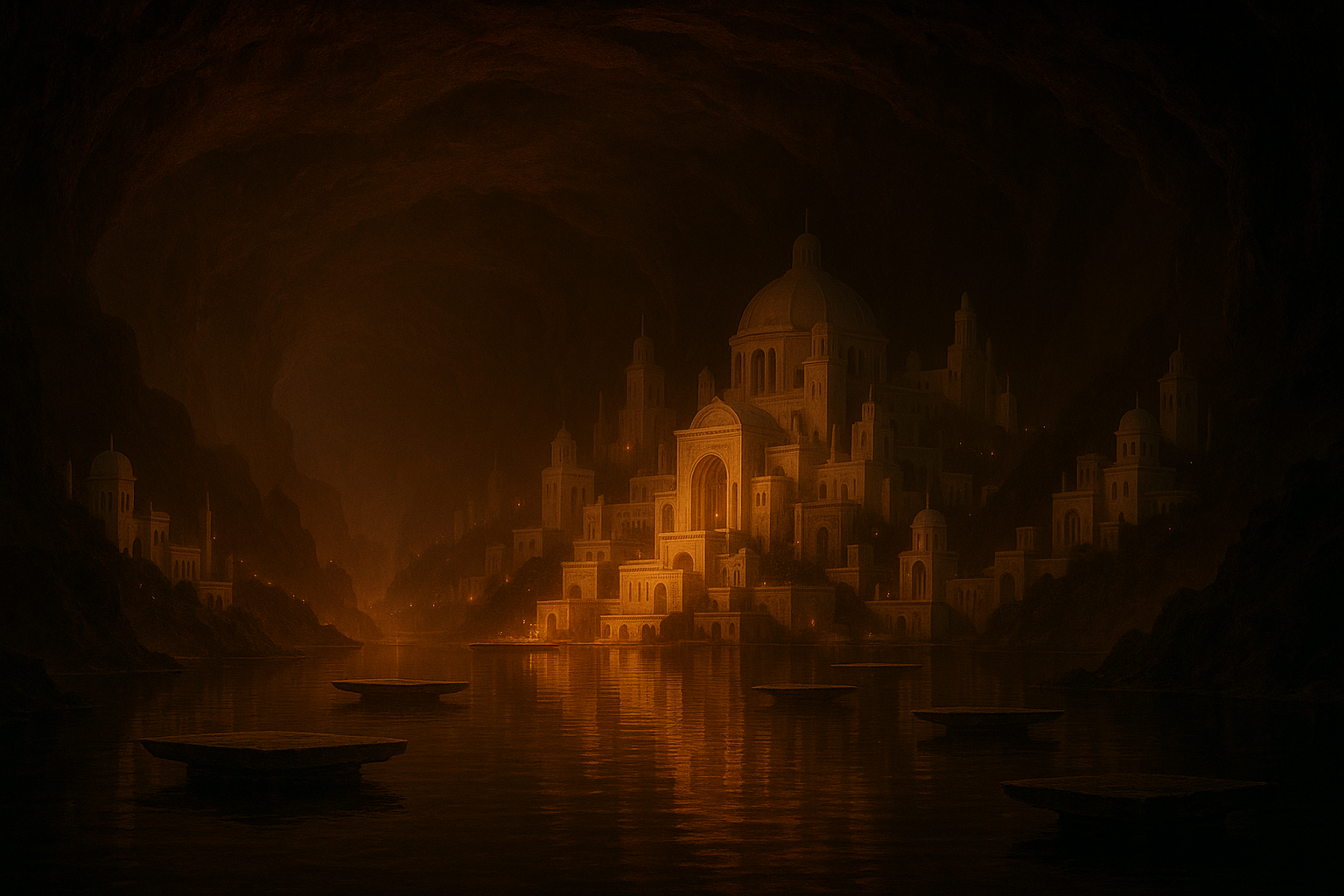
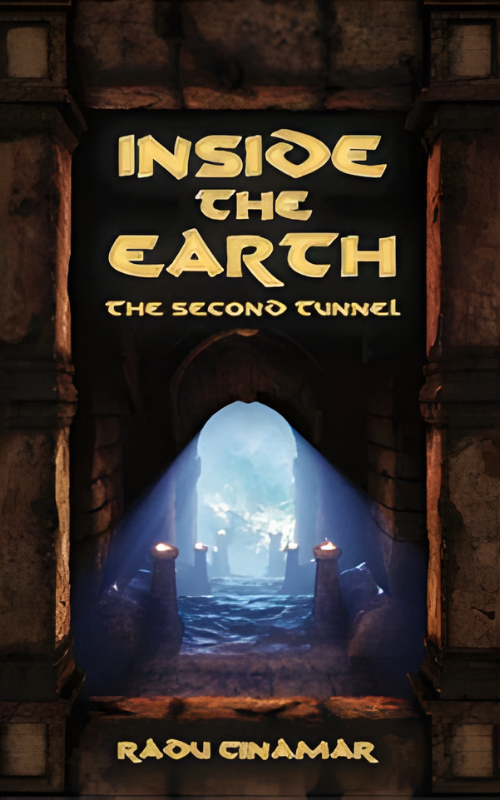
According to the book Inside the Earth, the Second Tunnel written by Radu Cinamar, Tomassis is an enigmatic underground city hidden beneath Romania. Tomassis is located several hundred kilometers below the Earth’s crust, in the transition zone to the etheric plane. It is a physical world, but with a more refined matter and a higher vibration frequency than on the surface. The cavity that houses the city is not huge, but it encompasses the shore of a calm inland sea, creating an ecosystem completely different from that on Earth.
Atmosphere, vegetation, and fauna
The sky in Tomassis is permanently covered, and the light comes from the radiation of the lava above the cavity, which ionizes the atmosphere, giving it a reddish-yellow twilight hue. The vegetation is dwarf, with broad, fleshy leaves adapted to low light, and the fauna is sparse—only a few medium-sized birds inhabit this space. The temperature corresponds to a subtropical region, with a humid atmosphere and light breezes.
Population and origins
Tomassis is home to direct descendants of the ancient Dacians, a people who have preserved their genetic and spiritual purity for thousands of years. The place was originally inhabited by evolved non-human beings, and the human population settled here en masse after the Roman conquest of Dacia, when the Dacian priests chose to retreat in order to protect their cultural and spiritual values.
The environment infuses pure energy, which balances the mind and body, giving residents a sense of well-being and inner joy.
Access and technology
Entry into Tomassis is not through physical roads, but through “airlocks” or spatial distortions, natural or artificial. The city has advanced technology, from anti-gravity platforms to shuttles that bend space-time by converting the gravitational field into a magnetic field. Conventional transportation is absent, and people travel on foot in an environment with no visible industry.
Architecture and social organization
The city consists of low-rise buildings, with a maximum of two stories, in sober colors—white, beige, gray, shades of blue—with perfectly paved streets. The system of government is based on the “principle of wisdom”: a leader is chosen from among a group of wise men, assisted by administrators in fields such as science, construction, and research.
Daily life and culture
There are no internal conflicts in Tomassis. The population enjoys a balanced, calm, and intelligent life, sustained by the pure energy of the environment. The inhabitants speak an unknown language with influences from ancient Greek and Latin, but they also communicate telepathically.
Tomassis preserves precious historical documents—tablets and metal sheets—containing a detailed history of their civilization and the underground world.
A symbol of Dacian continuity
According to Radu Cinamar, Tomassis is much more than a hidden city: it is proof of a civilization that chose to survive and develop in a protected space, preserving the spirit and values of the ancient Dacians.


